

Every day, bilingual workers in Garden Grove face invisible barriers when a customer or manager judges them by their accent instead of their talent. These experiences are not just personal frustrations but examples of language-based discrimination that affect careers and self-worth. Understanding your rights and the legal definition of this discrimination is the first step to demanding fair treatment and building a path toward workplace respect and justice.
Table of Contents
- Language-Based Discrimination Defined and Debunked
- Common Forms in Customer-Facing Roles
- Legal Standards Under Federal and State Law
- Employee Rights and Employer Responsibilities
- Reporting Discrimination and Legal Remedies
Key Takeaways
| Point | Details |
|---|---|
| Language-Based Discrimination | Language discrimination marginalizes individuals based on their linguistic traits and can significantly impact their careers. |
| Legal Protections | Title VII of the Civil Rights Act protects against language discrimination, requiring employers to justify language requirements as essential for job performance. |
| Employer Responsibilities | Employers must create inclusive policies that respect linguistic diversity while ensuring clear communication without discrimination. |
| Reporting Discrimination | Employees can report instances of language discrimination through the EEOC and must document incidents thoroughly to support their claims. |
Language-Based Discrimination Defined and Debunked
Language-based discrimination represents a pervasive and often overlooked form of workplace prejudice that systematically marginalizes individuals based on their linguistic characteristics. Linguistic discrimination emerges when employees experience unfair treatment connected to their language use, accent, dialect, or communication style.
At its core, language discrimination transcends simple communication barriers. It is a complex social phenomenon rooted in cultural biases and power dynamics that unfairly judge individuals’ professional capabilities through the lens of language. The impacts are profound: non-native speakers frequently encounter barriers in hiring, promotion, workplace interactions, and professional development opportunities.
Key manifestations of language-based discrimination include:
- Requirement of unnecessary English-only policies
- Negative performance evaluations based on accent
- Exclusion from informal workplace communications
- Reduced opportunities for advancement
- Microaggressions targeting linguistic differences
Historically, language discrimination policies have deep connections with systemic racism and colonial power structures. These policies often masquerade as attempts to promote workplace unity, when in reality they serve to marginalize and exclude non-dominant language speakers.
Legal protections exist to combat such discriminatory practices. Title VII of the Civil Rights Act provides critical safeguards against language discrimination when it constitutes a form of national origin discrimination. Employers cannot implement language requirements unless they are demonstrably essential for job performance and represent a legitimate business necessity.
Pro tip: Document every instance of language-based discrimination meticulously, including dates, witnesses, and specific discriminatory actions, to build a strong legal case.
Common Forms in Customer-Facing Roles
Language discrimination in customer service environments takes on multiple nuanced and insidious forms that systematically undermine professional opportunities for bilingual and non-native English speakers. Linguistic racism in service industries represents a pervasive challenge that extends far beyond simple communication barriers.
Customer-facing roles frequently expose employees to discriminatory practices that manifest through several distinct mechanisms:
- Accent-based performance evaluations
- Preferential treatment for employees with “standard” American English
- Disproportionate criticism of communication styles
- Assumptions about competence based on linguistic background
- Unequal assignment of challenging customer interactions
Accent bias represents one of the most pronounced forms of linguistic discrimination. Employees with non-standard American English accents often experience subtle yet systematic marginalization, including being perceived as less competent, professional, or trustworthy, despite equivalent skill levels and job performance.
These discriminatory practices create significant workplace barriers. Managers might unconsciously (or intentionally) limit advancement opportunities, assign less prestigious client interactions, or consistently scrutinize communication patterns more critically for employees with distinct linguistic backgrounds.
Language discrimination isn’t just about words – it’s about power, identity, and systemic exclusion in professional environments.
Employees experiencing such discrimination have legal protections under federal and state employment laws. Title VII of the Civil Rights Act provides critical safeguards against language-based discrimination when it constitutes national origin discrimination.

Pro tip: Document every instance of language-based workplace treatment, including specific interactions, dates, and potential witnesses, to build a robust legal case if discrimination occurs.
Legal Standards Under Federal and State Law
Federal employment law provides robust protections against language-based discrimination, establishing clear guidelines for employers regarding linguistic requirements in the workplace. Federal language requirements mandate that any language restrictions must be directly job-related and consistent with business necessity.
Key federal legal protections against language discrimination include:
- Title VII of the Civil Rights Act
- Equal Employment Opportunity Commission (EEOC) guidelines
- Executive Order 11246
- National origin discrimination provisions
- Reasonable accommodation requirements
Workplace language policies must meet stringent legal standards to avoid discriminatory practices. Employers cannot implement blanket English-only rules without demonstrating a legitimate business justification. The burden of proof lies with the employer to show that language restrictions are essential for job performance and not merely a pretext for discrimination.
State-level protections often extend beyond federal guidelines, providing additional layers of defense for employees. Some states, including California, have particularly robust laws that offer more comprehensive protections against linguistic discrimination. These state-specific regulations can provide employees with additional avenues for legal recourse when facing language-based workplace discrimination.
Language discrimination is not just a communication issue – it’s a fundamental civil rights concern that undermines workplace equality and individual dignity.
The legal framework requires employers to:
- Demonstrate business necessity for language restrictions
- Apply language policies consistently
- Avoid using language requirements as a proxy for national origin discrimination
- Provide reasonable accommodations for linguistic differences
- Maintain transparent and job-related language policies
Pro tip: Collect and preserve all documentation related to potential language discrimination, including workplace communications, performance evaluations, and witness statements, to strengthen potential legal claims.
Here’s a quick overview of legal protections for language-based discrimination:
| Protection Type | Federal Law Example | State Law Example |
|---|---|---|
| Workplace Policy Safeguards | Title VII of the Civil Rights Act | California Fair Employment Act |
| Enforcement Agency | EEOC investigations | State civil rights commissions |
| Remedies Offered | Damages, reinstatement, policy changes | Additional compensation, expanded protections |
| Coverage Scope | National origin and language restrictions | Broader linguistic coverage in certain states |
Employee Rights and Employer Responsibilities
In Garden Grove’s diverse workplace landscape, employees and employers must navigate complex legal obligations regarding language usage and workplace communication. Employee rights list provides critical guidance for understanding the delicate balance between professional communication standards and linguistic discrimination protections.
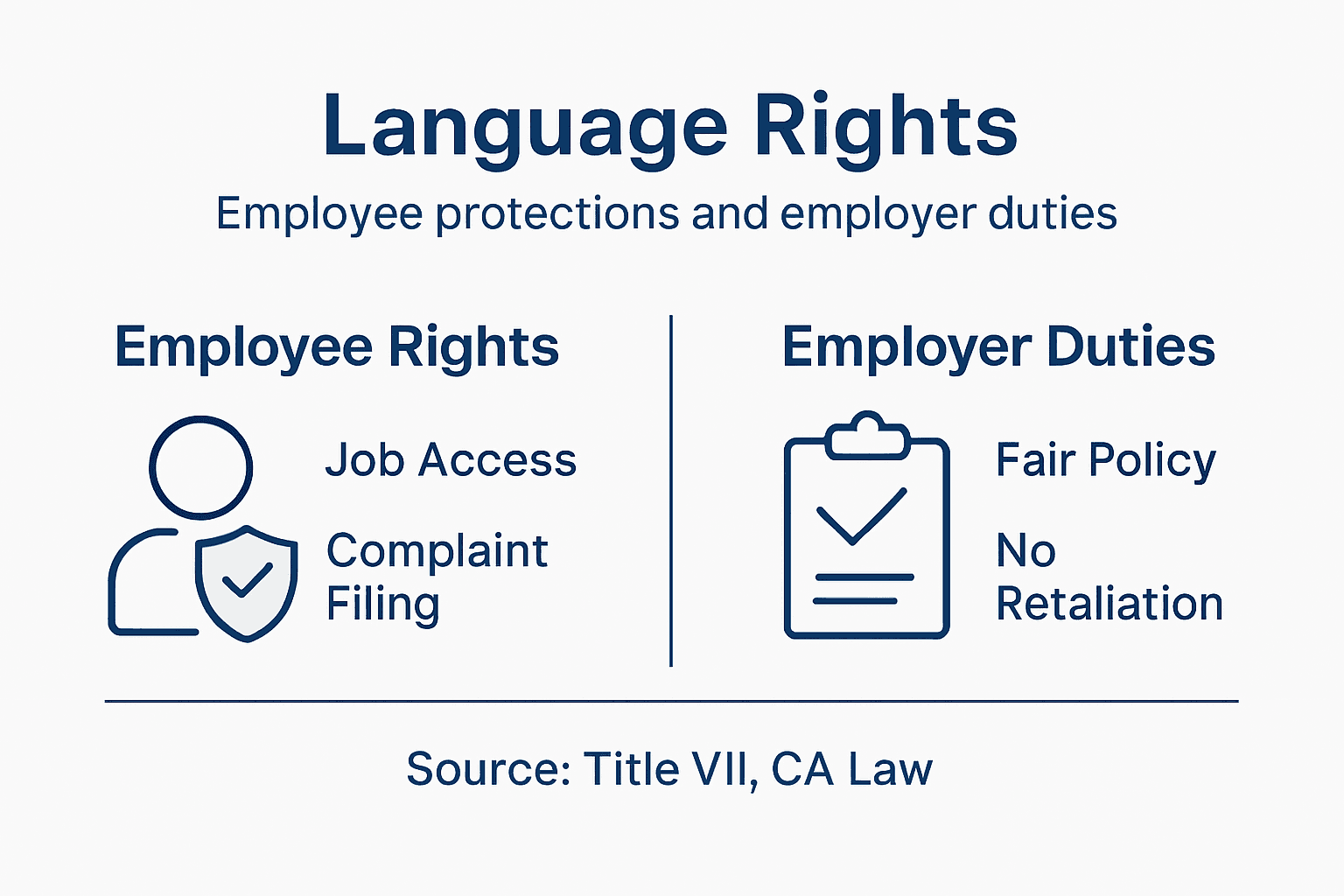
Employee rights in language-related workplace interactions include:
- Protection from discriminatory language policies
- Right to communicate effectively in professional settings
- Reasonable accommodations for linguistic differences
- Equal opportunity for job assignments and promotions
- Protection from retaliatory actions
Employer responsibilities extend beyond merely avoiding discriminatory practices. Organizations must proactively create inclusive environments that respect linguistic diversity while maintaining clear communication standards. This requires carefully crafted policies that distinguish between legitimate business communication needs and arbitrary language restrictions.
Key employer obligations include developing language policies that:
- Are directly related to job performance requirements
- Apply consistently across all employee groups
- Do not disproportionately impact specific national origin groups
- Provide clear written guidelines
- Allow for reasonable communication accommodations
Workplace language policies must serve operational needs without marginalizing employees’ cultural identities.
Employers must recognize that language diversity represents a strength, not a weakness. Effective communication strategies should embrace multilingual capabilities while maintaining professional standards that support business objectives.
Pro tip: Develop written language policies that explicitly outline communication expectations, emphasizing job-related linguistic requirements while avoiding overly broad or discriminatory restrictions.
See how employee rights and employer responsibilities differ in workplace language policies:
| Aspect | Employee Rights | Employer Responsibilities |
|---|---|---|
| Protection from Discrimination | Guaranteed by federal law | Must avoid restrictive policies |
| Communication Accommodation | Right to reasonable adjustments | Obligation to provide fair solutions |
| Job Advancement | Equal opportunity regardless of language | Apply policies fairly across all employees |
| Policy Transparency | Access to clear guidelines | Develop and share written standards |
Reporting Discrimination and Legal Remedies
Navigating the complex landscape of language discrimination requires understanding the precise mechanisms for reporting and seeking legal recourse. Discrimination reporting process provides employees with critical pathways to challenge unfair workplace practices and protect their professional rights.
Employees experiencing language-based discrimination have multiple reporting channels:
- Filing a charge with the Equal Employment Opportunity Commission (EEOC)
- Documenting specific discriminatory incidents
- Consulting with employment law specialists
- Requesting internal workplace investigations
- Pursuing administrative or legal remedies
Legal remedies for language discrimination can be comprehensive and potentially transformative for affected employees. Successful claims may result in various forms of compensation and workplace changes, including:
- Monetary damages for lost wages
- Reinstatement to previous position
- Compensation for emotional distress
- Mandatory workplace policy revisions
- Potential punitive damages against employers
The EEOC investigation process involves careful documentation and strategic evidence gathering. Employees must provide detailed accounts of discriminatory incidents, including dates, specific language-related actions, and potential witnesses that demonstrate a pattern of unfair treatment.
Timely and precise documentation is the cornerstone of successful language discrimination claims.
Employees should understand that legal protections extend beyond immediate job circumstances. Retaliation for reporting language discrimination is explicitly prohibited, ensuring workers can confidently assert their rights without fear of professional consequences.
Pro tip: Maintain a contemporaneous written log of all discriminatory incidents, including exact dates, specific language used, and potential witnesses, to build a robust legal case.
Protect Your Rights Against Language-Based Discrimination in Garden Grove Workplaces
Facing unfair treatment at work because of your language or accent can feel isolating and unjust. This article highlights key challenges like unnecessary English-only policies, accent bias, and exclusion from opportunities that affect many employees in Garden Grove. If you are struggling with language discrimination or want to understand your rights under Title VII and state laws, you are not alone.
At Serendib Law Firm, we are committed to fighting workplace discrimination and advocating for employees just like you. Our experienced attorneys understand the complexities of language-based discrimination cases and provide personalized support tailored to Garden Grove residents. Don’t wait until unfair treatment impacts your career or well-being. Visit our Garden Grove Archives | Serendib Law Firm to learn how we can help protect your rights. Contact us today through our main site Serendib Law Firm to schedule a free consultation and take the first step toward justice and fair treatment in your workplace.
Frequently Asked Questions
What is language-based discrimination?
Language-based discrimination occurs when individuals face unfair treatment in the workplace due to their language use, accent, dialect, or communication style, often leading to marginalization and missed opportunities.
What legal protections exist against language discrimination?
Legal protections include Title VII of the Civil Rights Act, which prohibits discrimination based on national origin, and requires that any language restrictions in the workplace must be essential for job performance.
How can employees report incidents of language discrimination?
Employees can report language discrimination by filing a charge with the Equal Employment Opportunity Commission (EEOC), documenting incidents, consulting with employment law specialists, or requesting internal investigations.
What rights do employees have regarding language use in the workplace?
Employees have the right to protection from discriminatory language policies, the right to communicate effectively, reasonable accommodations for linguistic differences, and equal opportunities for promotions and job assignments.
Recommended
- Language Discrimination and National Origin Claims in Garden Grove | Serendib Law Firm
- Experienced Garden Grove Workplace Discrimination Lawyers
- National Origin Discrimination—Impacts in Garden Grove Manufacturing | Serendib Law Firm
- Religious Discrimination in Garden Grove Food Service | Serendib Law Firm
- Employment Lawyer Long Beach – Los Angeles Employment Lawyers | California United Law Group, P.C.
One Response