

Here’s a comprehensive guide to religious holiday PTO conflicts for Garden Grove employees. Religious holidays often collide with workplace schedules, sparking questions about employee rights and company policies. Nearly 50 percent of workers admit they have faced challenges when requesting time off for religious reasons. Navigating these conflicts matters for both employees who want to honor their beliefs and employers who must balance fairness with business needs. This article breaks down the laws, explores common scenarios, and offers practical solutions for handling religious holiday and PTO conflicts in today’s workplaces.
Table of Contents
- Religious Holiday Scheduling and PTO Conflicts Defined
- Relevant Federal and California Employment Laws
- Accommodating Diverse Religious Observances at Work
- Employer and Employee Rights and Obligations
- Resolving Scheduling Disputes and Potential Legal Risks
Key Takeaways
| Point | Details |
|---|---|
| Legal Requirement for Accommodation | Employers must provide reasonable accommodations for employees’ religious observances unless it causes undue hardship. |
| Collaborative Process | Effective resolution of scheduling conflicts requires open communication and active engagement from both employers and employees. |
| Proactive Strategies | Implementing flexible scheduling and clear policies can help minimize workplace disruptions and legal risks. |
| Documentation | Maintaining accurate records of accommodation requests and discussions is essential for mitigating potential legal liabilities. |
Religious Holiday Scheduling and PTO Conflicts Defined
Religious holiday scheduling conflicts represent complex workplace interactions where employees’ religious observance needs intersect with professional time-off policies. According to the EEOC, employers are legally required to provide reasonable accommodations for employees’ sincerely held religious beliefs unless such accommodations would create undue hardship for the organization.
In practical workplace scenarios, these conflicts typically emerge when an employee’s religious holiday observance does not align with standard company paid time off (PTO) schedules. The Department of Labor emphasizes that employers must proactively work to find balanced solutions that respect both organizational operational needs and individual religious practices.
Key aspects of religious holiday PTO conflicts include:

- Identifying specific religious observance dates
- Understanding employee’s sincere religious beliefs
- Evaluating potential workplace accommodation options
- Balancing operational requirements with individual religious needs
Successful resolution requires open communication, mutual respect, and a collaborative approach that recognizes the importance of both organizational productivity and employee religious freedom. Religious Discrimination and Holiday Conflicts in Anaheim | Serendib Law Firm provides additional insights into navigating these nuanced workplace interactions.
Relevant Federal and California Employment Laws
Employment law regarding religious holiday accommodations stems from two critical legal frameworks: federal and state regulations that protect employees’ rights to observe religious practices. Wikipedia notes that Title VII of the Civil Rights Act of 1964 explicitly prohibits employment discrimination based on religion, requiring employers to provide reasonable accommodations for employees’ religious observances.
In California, the state’s legal protections extend beyond federal standards. The California Fair Employment and Housing Act (FEHA) provides robust safeguards for employees, mandating that employers make reasonable accommodations for religious practices while ensuring that such accommodations do not create undue hardship for the organization.
Key legal protections under these frameworks include:
- Prohibition of religious discrimination in hiring, promotion, and termination
- Requirement for employers to explore flexible scheduling options
- Protection of employees’ right to observe religious holidays
- Mandate for interactive dialogue to find suitable workplace accommodations
Navigating these complex legal requirements often requires specialized expertise. Employers and employees can gain deeper insights into nuanced religious accommodation challenges through our California Employment Law Archives, which provide comprehensive guidance on interpreting and implementing these critical legal protections.
Accommodating Diverse Religious Observances at Work
Workplace religious accommodation requires a nuanced, proactive approach that respects both employee beliefs and organizational operational needs. According to the EEOC, employers have several strategies to accommodate diverse religious observances, including flexible scheduling, voluntary shift swaps, and potential job reassignments that minimize workplace conflicts.
The Department of Labor emphasizes that effective accommodation goes beyond simple scheduling adjustments. It involves creating an inclusive workplace culture that genuinely respects religious diversity, recognizing that employees may require different approaches to meet their spiritual observance requirements while maintaining professional responsibilities.
Practical accommodation strategies include:
- Allowing flexible start and end times
- Permitting shift exchanges between willing employees
- Creating quiet spaces for prayer or meditation
- Developing clear, consistent policies for religious holiday time off
- Encouraging open communication about religious observance needs
Navigating these complex workplace interactions often requires specialized legal guidance. Employers seeking deeper insights into managing religious accommodation challenges can explore our comprehensive guide on understanding religious discrimination lawsuits and holiday observances, which provides detailed strategies for creating inclusive workplace environments.
Employer and Employee Rights and Obligations
Religious accommodation in the workplace creates a collaborative responsibility between employers and employees, with each party having specific legal rights and obligations. According to the EEOC, employers are legally required to provide reasonable accommodations for employees’ religious practices, unless doing so would cause undue hardship to the organization.
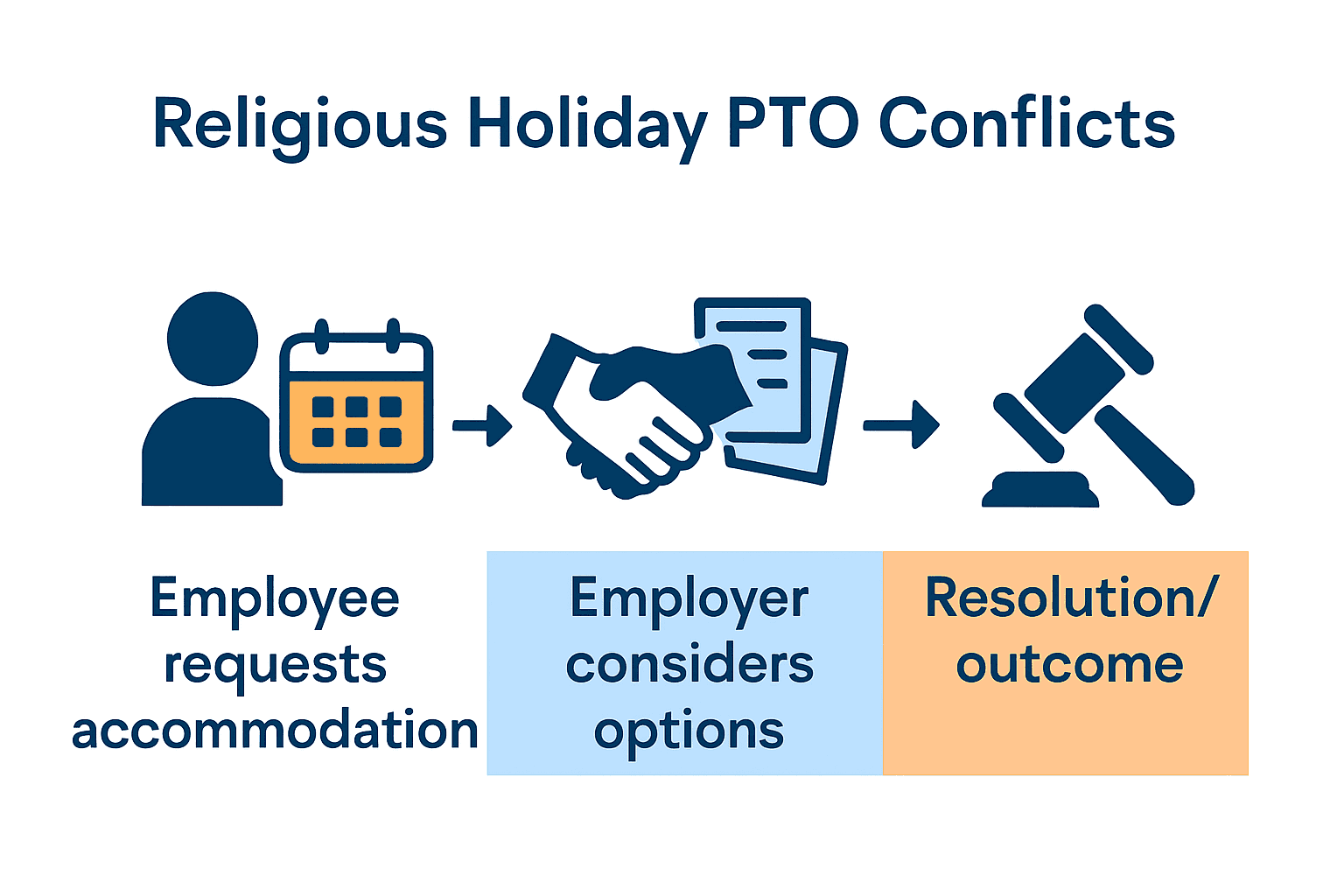
The Department of Labor emphasizes the importance of an interactive process where both parties must actively engage in finding mutually acceptable solutions. Employees bear the responsibility of clearly communicating their religious needs, while employers must demonstrate a good-faith effort to understand and accommodate those requirements.
Key rights and obligations for both parties include:
- Employers must explore flexible scheduling options
- Employees must provide timely notification of religious observance needs
- Both parties should engage in open, respectful dialogue
- Employers cannot discriminate based on religious practices
- Employees must perform essential job functions
Employers seeking comprehensive guidance on navigating these complex interactions can refer to our Employee Rights List, which provides detailed insights into the nuanced legal landscape of workplace religious accommodations.
Resolving Scheduling Disputes and Potential Legal Risks
Navigating religious holiday scheduling conflicts requires a strategic approach that minimizes both workplace disruption and legal exposure. According to the EEOC, employers must proactively explore flexible resolution strategies, such as voluntary shift swaps and creative scheduling arrangements that accommodate religious observances without creating undue hardship.
The Department of Labor emphasizes that proactive conflict resolution is crucial in preventing potential legal liabilities. This involves developing clear communication protocols, documenting accommodation attempts, and maintaining a consistently fair approach to religious accommodation requests across all employee groups.
Key strategies for mitigating legal risks include:
- Documenting all accommodation discussions
- Maintaining consistent policies for religious observance
- Exploring multiple accommodation options
- Avoiding discriminatory scheduling practices
- Conducting periodic training on religious discrimination
Employers facing complex scheduling challenges can benefit from understanding the nuanced legal landscape of employment disputes.
 For comprehensive insights into navigating potential legal complexities, explore our guide on arbitrations in employment law cases, which provides critical guidance on resolving workplace conflicts effectively.
Protect Your Rights Around Religious Holiday PTO Conflicts in Garden Grove
Dealing with religious holiday scheduling conflicts at work can feel overwhelming, especially when your sincere beliefs collide with workplace policies. If you find yourself struggling to balance your faith and job responsibilities, you are not alone. These challenges often involve navigating complex legal protections around reasonable accommodations and understanding your rights under both federal and California laws.
At Serendib Law Firm, we understand the emotional and professional toll these conflicts can take. Our experienced team is dedicated to helping Garden Grove employees and employers find fair solutions that respect religious observances while addressing workplace needs. Explore our Garden Grove Archives to learn more about local legal guidance and start protecting your rights today. Don’t wait for a conflict to escalate. Visit Serendib Law Firm now and take the first step toward clear answers and personalized legal support. For broader insights on workplace disputes in the Orange County area, check out our Orange County Archives and see how we can advocate for you.
Frequently Asked Questions
What are religious holiday PTO conflicts?
Religious holiday PTO conflicts occur when an employee’s need to observe a religious holiday does not align with the standard paid time off (PTO) policies of the workplace.
What are employers required to do regarding religious accommodations?
Employers are legally required to provide reasonable accommodations for employees’ sincerely held religious beliefs unless accommodating such requests would cause undue hardship to the organization.
How can employers accommodate diverse religious observances at work?
Employers can accommodate religious observances through strategies such as flexible scheduling, allowing shift swaps among employees, and creating policies that respect various religious needs.
What should employees do if they face scheduling conflicts due to religious holidays?
Employees should communicate their religious observance needs to their employer in a timely manner and engage in an open dialogue to explore potential accommodations.